
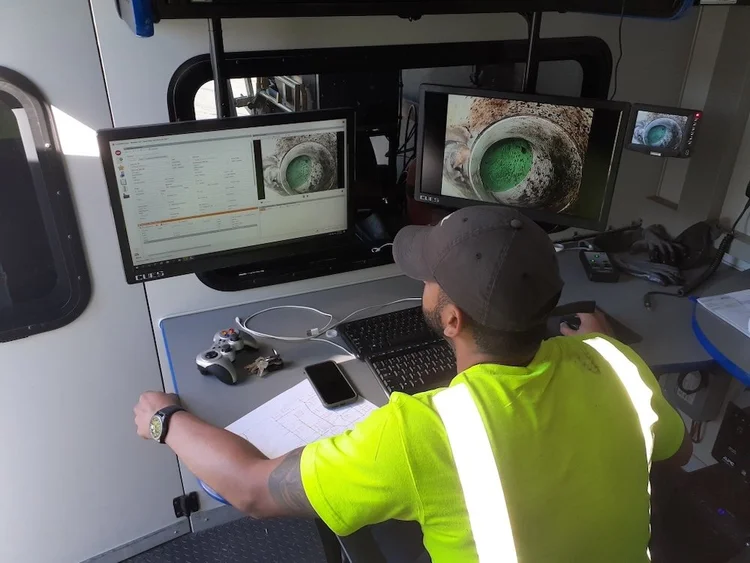
A sewer lateral inspection is a camera survey of the private pipe that carries wastewater from a building to the public sewer main. A small CCTV camera travels through the lateral and records cracks, root intrusion, sags, offset joints and blockages, so the owner knows the pipe’s condition before a problem turns into a backup or a dig-up.
Laterals are easy to forget because they are buried and usually belong to the property owner, not the city. In Florida, old clay and cast iron laterals are a common source of root problems, backups and groundwater leaking into the sewer. This guide explains how an inspection works, when you need one and what the report tells you.
What is a sewer lateral?
The sewer lateral is the pipe between a building’s plumbing and the sewer main in the street. Many cities split it into an upper lateral (building to cleanout or property line) and a lower lateral (property line to the main). Who owns and maintains each part depends on the local utility, so check your city or county rules before planning repairs.
How a sewer lateral inspection works
- Access: the crew enters through a cleanout near the building, or launches a lateral camera from the sewer main through a manhole.
- Cleaning if needed: heavy grease or roots are cleared first so the camera can see the pipe walls.
- Video survey: the camera records the full length of the line, with distance shown on screen.
- Coding and report: defects are logged by location and severity, often using NASSCO LACP coding, and delivered with video and photos.
When you need a sewer lateral inspection
- Repeated backups or slow drains in more than one fixture
- Gurgling toilets or sewage odors outdoors
- Before buying or selling a commercial property or older home
- Before paving, landscaping or building over the lateral
- When a utility runs an inflow and infiltration (I&I) reduction program
- After tree roots, settlement or nearby construction
What the inspection can find
Common findings include root intrusion at joints, cracks and fractures, sags where water and solids collect, offset or separated joints, broken pipe, and a poor connection to the main. Each finding points to a different fix, from cleaning and root cutting to lining or a point repair.
What happens after the inspection
If the lateral is sound, the video becomes a baseline record. If it has defects, the report helps you compare options. Many laterals can be renewed without digging through sewer lateral rehabilitation, such as lining from the cleanout or the main. Severe breaks may need a point repair or replacement of a short section.
For cities and utilities, lateral inspections are often part of a wider sanitary sewer evaluation survey (SSES) to find where groundwater enters the system.
Frequently asked questions
What is a sewer lateral inspection?
It is a CCTV camera inspection of the private pipe that connects a building to the public sewer main. It records the pipe’s condition and shows defects such as roots, cracks, sags and offset joints.
How long does a sewer lateral inspection take?
Most single laterals take under an hour on site when there is a usable cleanout. Laterals that need cleaning first, or that are inspected from the main, can take longer.
Who is responsible for the sewer lateral in Florida?
It depends on the city or utility. Often the property owner is responsible for the lateral from the building to the property line or cleanout, and the utility owns the main. Check your local utility’s rules.
Can a damaged lateral be fixed without digging?
Often, yes. Lining and other trenchless methods can renew a lateral through a cleanout or from the main. A camera inspection shows whether the pipe is a good candidate.
Need a lateral inspected or a lateral program planned? Flotech provides sewer lateral inspection across Florida. Contact us or call (866) 299-3323.